
Middletown City Directory Collections
MidPointe Digital Archives is the main public starting point for a Middletown directory search. Its collection titled “Middletown City Directory Collection” covers 1891 through 2000, with stated missing years and no digitized volumes from 2001 forward. Some volumes also include Lemon Township, Madison Township, or Trenton, so retain the locality printed in the source rather than silently treating every result as Middletown. The collection provides browsing and full-text search, but MidPointe warns that the searchable text can be inaccurate. A search hit should lead to the scanned page, not replace it.
| Directory collection | Years documented | Repository | How to use it |
|---|---|---|---|
| MidPointe Middletown directory collection | 1891-2000, with stated gaps | MidPointe Digital Archives and Local History Collection | Public browsing and full-text search; check the page image. |
| Williams' Middletown Directory | Verified sample 1926-1927; microfilm examples 1917-1918, 1924-1925, and 1926-1927 | MidPointe, Ohio Room REF 917.71752 Mid 1926-27 | Alphabetical, business, household, street-guide, civic, and organization material. |
| MidPointe Local History Collection | Collection policy, not one continuous run | MidPointe Middletown branch | Local and eastern Butler County history in print, film, audiovisual, and digital formats. |
| Sanborn maps | 1885, 1890, 1895, 1901, 1907, and 1924 | Library of Congress | Street, block, building, and use context, not a list of occupants. |
The MidPointe record for the 1926-1927 Williams volume preserves the item metadata and scanned pages.
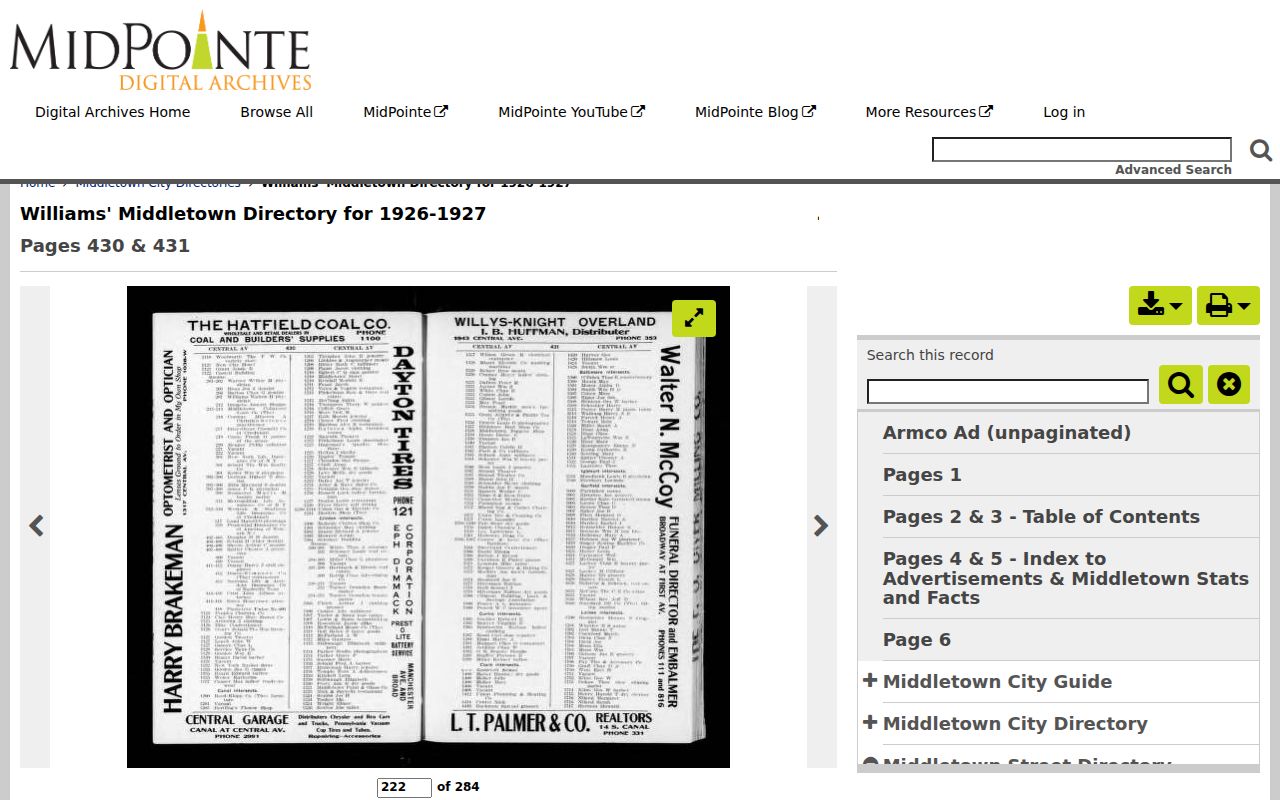
That volume is a concrete example of a Middletown directory that can be read in several ways, rather than as a single name list.
Middletown Directory Gaps
The archive lists missing years: 1892-1893, 1896-1906, 1909, 1911, 1913, 1915, 1921-1922, 1932, 1943, 1946, 1948, 1950, 1952, 1954, and 1989. A missing year may mean MidPointe lacks the volume or that no volume existed. It does not prove that the directory business stopped for each interval. Search the nearest earlier and later editions, then test an apparent move or disappearance against a deed, census, newspaper, probate item, or obituary.
Full-text OCR is useful for finding a likely page, especially when a surname is unusual. It is not a final transcription. Read names, numerals, initials, and street numbers directly from the scan. Save the edition, page or image number, spelling as printed, and the directory section used. Those details make a later correction possible when a second volume gives a different spelling.
Note: A gap calls for adjacent editions and a second dated source, not an assumption that a household stayed put or left town.
Middletown Directory Publishers
Publisher names change across the Middletown collection. Verified examples include A.T. Rittig & Company with Hamilton Printing in 1891, W.H. Todhunter & Co. in 1894-1895, Vick's Publishing in 1907-1908, Edgar Smith in 1910, 1912, 1914, and 1916, Williams Directory Company from verified 1917-1918 examples through mid-1970s examples, and R.L. Polk in verified later editions through 1992-2000. That chronology keeps one publisher's conventions from being projected onto the whole run.
- 1891: A.T. Rittig & Company and Hamilton Printing appear in a verified edition.
- 1894-1916: Todhunter, Vick's, and Edgar Smith appear in verified examples from this period.
- 1917 through mid-1970s examples: Williams Directory Company appears in verified editions.
- 1992-2000: verified later editions include R.L. Polk.
A publisher change can alter abbreviations, section order, and what is indexed. Check the volume title and its own front matter before comparing two entries.
Reading Middletown Directory Entries
The inspected 1926-1927 Williams directory is 550 pages long. Its contents identify an alphabetical arrangement of names at page 31, a City Guide at page 7, societies and organizations at page 25, public buildings at page 30, a Business Directory at page 485, and a Householders Directory with Street and Avenue Guide at page 421. The alphabetical part starts with a person or business. The street guide instead begins with a street and number, which makes the two sections useful for different questions.
| Street placement | A street heading and numeric address or range can locate an entry within the guide. |
|---|---|
| Listed identity | An individual, business, institution, building, or room occupant may be named; more than one name can appear at one number. |
| Use or detail | The entry can include an occupation, business type, room use, vacancy, furnished-room or hotel notation, or an intersection cue. |
| Cross street | Markers such as an intersecting street help compare an older number with the block layout. |
| Source citation | Keep the volume year, publisher, page/image, and exact printed spelling with the finding. |
- Street and Avenue Guide
- The address-first part of a volume, arranged in street and number order rather than by surname.
- Householder index
- A directory section intended to connect a listed household or address to its printed entry; its scope follows that edition.
- Abbreviation key
- The volume's own explanation of shortened terms. Read and save it before expanding a mark in an entry.
The MidPointe branch locations page gives the access details for in-person volume work.

Use a library visit to pair the digital image with the volume's front matter, local-history materials, and nearby editions.
Middletown Directory Listings Are Snapshots
A printed directory listing is evidence that a person, business, rooming house, institution, or vacancy appeared in that edition's canvass period. It is not a complete household count and it is not proof of continuous presence. The Central Avenue sample includes a hotel, furnished rooms, retail and repair uses, vacancies, a building with numbered rooms, and multiple listed names at one address. A person can be omitted, use initials, appear through a business, or be represented with a spouse or relative.
This distinction matters when a result is being used for family history or a property-history question. Phrase the finding as “listed at an address in the 1926-1927 directory,” then compare it with another dated record. A later parcel or deed record serves a different purpose and should not be used to rewrite what the historical directory actually printed.
Middletown City Directory Research Desks
The MidPointe Middletown branch is at 125 South Broad Street, Middletown, OH 45044, and lists 513-424-1251. Its published hours are Monday through Thursday from 10 a.m. to 7 p.m., Friday and Saturday from 10 a.m. to 5 p.m., and closed Sunday. The Local History and Genealogy Collection includes material about the civic, social, religious, cultural, political, economic, and historic life of Butler County, with an eastern Butler County emphasis.
The Middletown Historical Society Archives reports more than 50 archival collections, including 65 City of Middletown ledgers in MS-023, plus documents and images tied to Armco, the Middletown Journal, churches, business, deeds, ledgers, and school yearbooks. It does not publish a searchable item-level catalog or a verified fee schedule. Ask a focused question with a name variant, decade, street or building, organization, and material type.
The Historical Society archives page presents its collections and research-contact route.
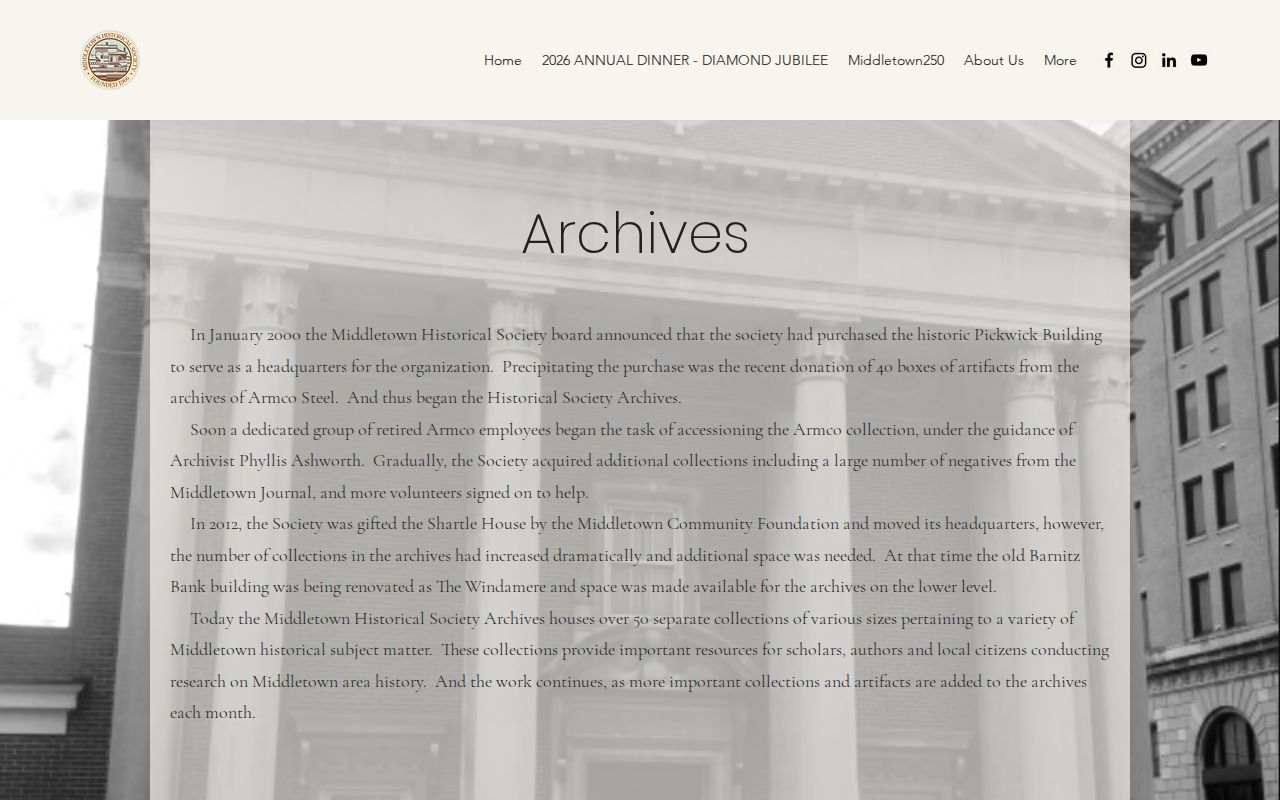
An archivist can identify whether a focused directory, yearbook, ledger, photograph, or newspaper request has an available access path.
Note: Ask staff about on-site review and reproduction permission before assuming that an item can be copied or emailed.
Tracing Middletown City Directories
Trace one surname or address across the available Middletown city directories, recording what the edition actually says. The goal is to build a dated sequence, not to force a continuous story through the archive gaps. The federal census is released after 72 years; as of 2026, 1950 is the newest open decennial census. Use a directory before and after a census year to bridge the years between, while keeping the census's household-relationship information separate from a directory listing.
- Start with the last known spelling, initials, address, or business name in an available volume.
- Check the alphabetical section for name variants, then the street guide or Householders section for the address.
- Record the year, publisher, page or image, directory section, address, printed name, any occupation or business clue, and cross street.
- Repeat in the prior and next available volumes, allowing for the stated gaps.
- Test a move, death, or changed household with census, deed, probate, obituary, or map evidence appropriate to its date.
When the question becomes a current parcel or street record rather than a historical listing, follow the Middletown By Street record trail after routing the address to the correct county.
Middletown Directory Maps and Archives
The Library of Congress 1924 Sanborn record is part of a verified Middletown map sequence for 1885, 1890, 1895, 1901, 1907, and 1924. The 1924 set has 39 sheets and names North Excello, South Excello, and West Middletown. A Sanborn sheet can date a building footprint, street layout, or use. It cannot name an occupant, so pair it with the directory entry and its edition date.
When a directory trail ends, the Ohio History Connection historic death index offers a separate name-and-date cross-check for ODH death certificates from 1913-1944 and 1954-1970. Earlier deaths were commonly kept in county ledgers. Historical Society collections may also supply city, church, school, newspaper, or industrial context, but a collection inquiry should never be treated as a guaranteed name search.
The Middletown Historical Society maintains the local preservation and research-contact route.
Its archival material is most useful when a dated directory entry, map sheet, or yearbook points to a specific family, place, institution, or organization.
Note: A map dates the physical setting, while a directory or vital source supplies a separate dated name clue.